
Run before you can walk.
Stop being the loser and start winning.

No one wants to be seen as a quitter.
The loser.
The one with no will power.
The one who didn’t try hard enough.
I hate losing.
And I hate being a beginner just as much. The countless times I got frustrated playing video games because I panicked under pressure and misclicked the buttons or stopped thinking logically infuriated me, not because I lost, but because I could see the mistakes I was making and didn’t know how to change them or be ‘better’ at the game itself.
Now we have an active gaming channel, reading the comments people say about me when I make a mistake, the belief: ‘you are shit’ is constantly re-affirmed, even when I try to ignore the words.
Once the anger subsided, I started to recognise a familiar pattern—one that extended far beyond gaming.
Some of these may sound familiar to you:
‘I avoid the unknown, or don’t try once I’ve hurt myself. My expectations limit my capacity to grow because I remove the enjoyment from learning.’
‘If I haven’t got the talent to begin with, what is the point in trying? Who truly enjoys being bad or an absolute beginner? No one.’
‘I lack the confidence to begin with because I lack ability, rather than choosing to accept my current position, I would rather refuse, avoid and dismiss any interest in learning.’
If we are aware these beliefs exist? What could be the potential sources?

Cognitive Distortion
Our earliest experiences in education often shape parts of our identity.
We are taught in School to pursue our interests and choose 1 area to specialise in, and eventually form a career centered around that one topic.
My secondary school had ‘Gifted and talented’ programme: students who possessed exceptional talent in a subject, were granted extra opportunities such as School trips and speaker events.
If you enjoyed the subject and were not selected, especially if your peers progress at a faster rate, it was easier to internalise the belief ‘you are incompetent’.
How often have you based decisions on a lack of competency or inner self-doubt over your ability to succeed? Is there an unwritten story you’ve pondered for years? Or were you not co-ordinated enough to play sport and decided fitness isn’t for you?
Despite being an ‘average’ student in school at Science, contemplating a Phd 5 years ago with my pre-meditated beliefs, would have discouraged me from even trying. I’m going to explain why change occurred shortly…
The Skill Gap: How We Acquire Competence
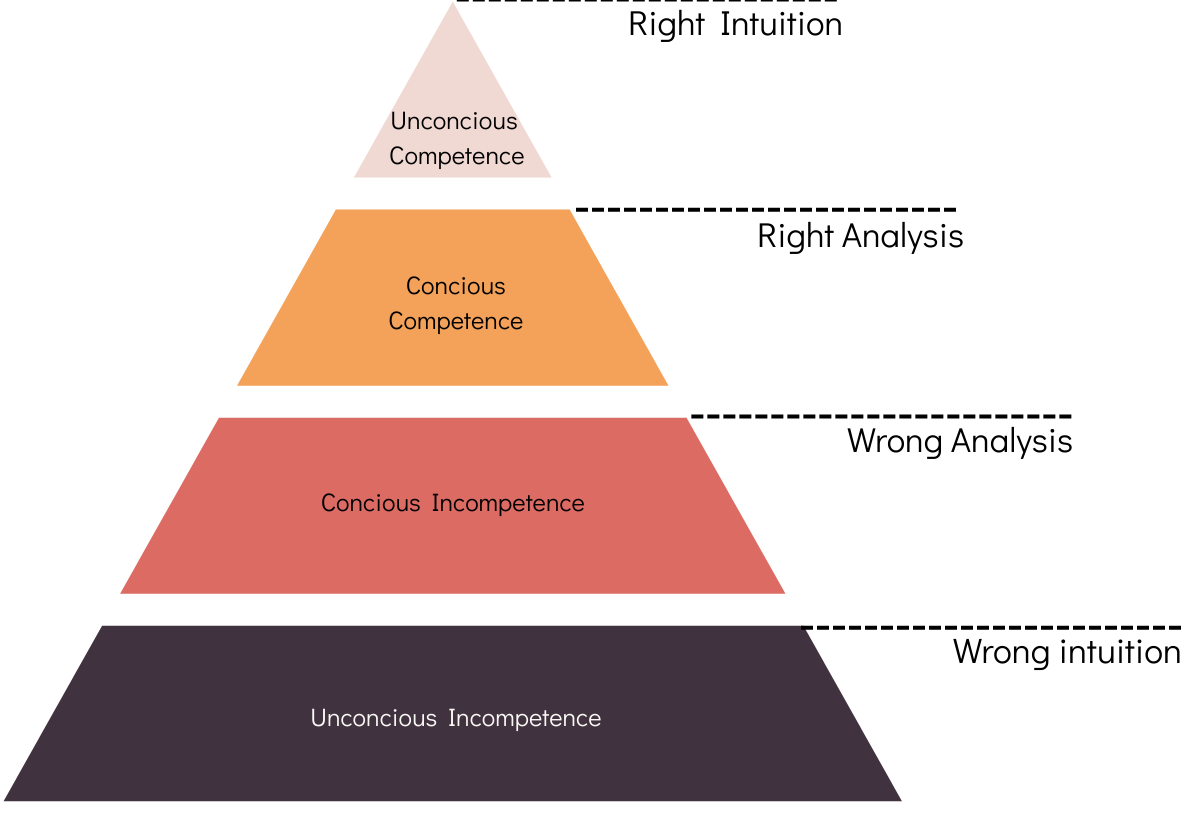
Acquiring a new skill often follows a predictable pattern and sequence of learning. Intially, we may doubt our ability to perform a skill based on how we perform, when reality its to do with the stage of learning1 you are currently at.
Unconcious Incompetence: A lack of knowledge based on a lack of skill. True beginners might ask questions like ‘what am I supposed to feel?’ or ‘Am I doing this correctly?’ In fitness, when performing a squat or deadlift, a true beginner might replicate the movement based on what they’ve read online or seen someone else do in the gym, without understanding bracing, intention and how to execute the movement correctly. This isn’t because they are incapable, it’s simply the starting point.
Conscious Incompetence: Here is where we develop awareness. Once you start to develop a greater understanding of the exercise, you are able to identify and correct mistakes more frequently. It can often be frustrating knowing you are repeatedly making small errors and need minor adjustments, but analysing mistakes, refining and putting in hours of deliberate practice will be like chipping away at a boulder until it starts to form a sculpture. Most people want to skip or avoid this stage because it can be extremely time consuming.
Conscious competence: With consistent practice and repetition, execution and progress increases linearly. The majority of exercises you can execute correctly as long as you pay attention. Internal cues and slight adjustments are much easier for you to identify and correct because you have created better self awareness. For example, you might notice a heel lift, elbow flaring out or shifting to one side in a squat, but you can recognise, adjust and correct more efficiently. This process can take 1.5-2 years of deliberate and consistent practice for most people and it becomes less frustrating. You can see the progression and learning curve, but attention is still required for you to execute movements correctly.
Unconcious Competence or mastery is the end goal, where skills are executed without concious thought. Like spelling your name or opening a door, you don’t have to focus on how to do it, you just know. Achieving this level of mastery is associated with high level athletes and those with hours of skin in the game. Even if you do reach this stage, automatic success is still not guaranteed in execution of movement. Fluctations occur in reflection of our physical state. Athletes get injured repeatedly, as do most of us, often due to a poorly executed movement or a mistake made during execution. The risk increases with more complex movements and the physical demands placed on the body, therefore, you simply cannot predict everything and calculate timelines on these stages because perfection does not exist.
Why this matters
The reality is no one likes being a true beginner. Many people understimate the time it takes to truly develop strength and skill in physical training. If you offer a 2-year transformation to someone who wants instantaneous or short term results, they will often walk out, unwilling to commit for that time period.
They avoid being the ‘quitter’ because they never started.
Each stage of learning is both essential for personal growth. Expecting to develop competency without time and patience is like trying to run before you walk. Developing strength, co-ordination and efficiency requires progressive development. Skills take time and deliberate practice to master (10,000 hours approximately) and skipping or avoiding stages ultimately leads to frustration when you continue to fail and reinforce the beliefs that you are not ‘good enough’.
Practical application
While goals can create the overarching vision of what we are trying to achieve, I often discuss the following with clients :
How can you overcome the challenges of being a beginner, knowing the learning curve is vast?
How do you find the capacity to continue to grow when we feel overwhelmed and frustrated?
How can you stay motivated when you feel like the progression has stopped?
Whilst certain factors can be advantageous such as: current lifestyle habits, genetics, training experience/ history, resilience and mindset, they don’t overrule the potential for achieving results and change.
Manage your expectations
If you are learning a new skill, your mindset will hugely determine your experience and success. Ingrained, subconscious movement patterns can take years to correct and unlearn, therefore patience and consistency within this period is essential. Externally driven goals such as the number on the scale become easier to fixate on as the metric of progress, but we forget about internal goals like feeling stronger, improved digestion and more balanced energy levels. Creating smaller intermediate goals will help to both improve consistency and keep you on track for your bigger goals, because expectations will be managed more effectively.
Patience and consistency is not simply a tool to motivate you, but an objective strategy designed to help you succeed.
Be A Proactive Student:
Instructions alone have no meaning if you lack the understanding.
Wholeheartedly commiting to the process of improving your lifestyle retains long lasting results if both care and curious are implemented. Understanding the benefits of certain behaviours creates a clearer purpose behind your actions. This acknowledges the bigger picture: you are not simply ‘losing weight’ or ‘building muscle’ but improving your health. Applying intention to instructions, becomes plausible once we understand the purpose and meaning behind them.
Be the proactive student and master your health because you care about how you will live the remaining years of your life.
5-Minute Cool Downs
From personal experience, when I become frustrated with failing or making a mistake, I allow myself to get the frustration out of my system and after 5-minutes I have to let it go. Continuing to fixate and obsess over your mistakes is like adding more fuel to the fire, without just letting it die out. We know when people say ‘just let it go’, it can piss you off more! Why? Because they are right. But instantaneously getting over it isn’t always the best practice. You just need 5 minutes to diffuse. Let the emotions run wild, but avoid projecting your frustration on others. Once emotions begin to settle, reflect, acknowledge and move forward.
Frustration and anger are normal emotions to experience when we are learning new skills, so allow yourself the time to breathe but not long enough for it to prevent you moving forward.
The 1% rule:
Since last September I started using this in my training and it has helped me reach multiple PR’s and smaller goals I set for myself. It’s really hard to scale progression in training when focusing on lifting ‘X’ amount of weight each week is the main goal, otherwise you are not improving.
While external metrics of progress can be great, it fails to address intention and internal focus. Psychological techniques such as Visualisation can improve performance2, pain tolerance, anxiety and stress, by simply creating a mental image of the task you are trying to replicate or execute.
When I start missing reps or begin to focus on how fatigued I am starting to feel, my technique gets worse. Despite the physical awareness of my change in state, I try to push harder each time and conjure up energy I don’t have and tell myself I just need to ‘man up and stop being pathetic’. It never worked.
I started shifting my internal focus in these moments to ‘can I give 1% more on the next rep?’. The answer is always ‘yes’. If I failed again, I take a deep breath and repeat, ‘1% more’. Over the course of the set, from rep 1 to 10, the incremental increase in intensity and intention made it easier to manage. I would not add more weight and sometimes even reduced it, but kept the intention the same.
Next time you feel this half way through a session or set, ask yourself, can you give 1% more this time? Over how many sets that can range from 3-10% or more depending on what you are doing!
Small intention, repeated consistently, compounds faster than forced effort.
2 Week Adjustments
The minimum amount of time I give before implementing any changes to a programme is 2 weeks and I even push this to a month normally. This applies to everything, exercise in particular. Most people want to switch up workouts constantly and while it may work initially for a novice lifter, random programmes lead to random results because they lack specificity. As discussed previously, patience and consistency are the two important variables for a beginner to align with, so sporadic training and constantly making big changes will limit your capacity to establish a routine and truly identify the areas you need to work on.
Our bodies are not static, we fluctuate on a daily and even hourly basis. Women experience prominent hormonal fluctuations around their cycle, stress, sleep and daily life ultimately affect how our bodies respond to food and exercise.
Slashing your calories by half after your first week of dieting or increasing training volume from 3 to 6 days a week is unsustainable for most people, so you cannot expect to retain any results that exist in extreme circumstances.
Most exercises are different variations of different movement patterns, so figuring out what works best for your body is important, but also giving yourself enough time to figure out if the issue was execution of the movement or just not suited to your mechanics is valuable information.
Giving yourself a 2-week time frame before making any changes will allow you to adapt and adjust accordingly to your body and your needs and overall give you more autonomy about how to navigate lifestyle changes incrementally.
Closing Thoughts
While pre-existing beliefs about capabilities can be influenced by around early life experiences, they do not ultimately determine your current capacity to learn and develop in adulthood. Competency and skill acquisition are built through action and deliberate practice. Being a beginner will be frustrating at times and test your patience- but consistency, not perfection, is the main determinant of success.
Being the quitter is ultimately a choice.
Thank you for reading :)
https://www.revolutionlearning.co.uk/article/conscious-competence-learning-model/
https://discobolulunefs.ro/media/September2020.4.pdf